Quinn Mitsuko Parker didn’t start out studying gender— at least not officially. For over two and a half years, she collaborated with coastal communities in southeast Madagascar to identify the challenges, and pathways, to achieving sustainable livelihoods. Along the way, she began to see gender as a central piece of the puzzle, revealing who is most impacted by climate change, and why. Now, as a Ph.D. student at Stanford, her research combines sustainability and gender studies. “I want to explore not just how to reduce climate impacts,” Parker explains, “but how to reduce the conditions that produce unequal vulnerability.”
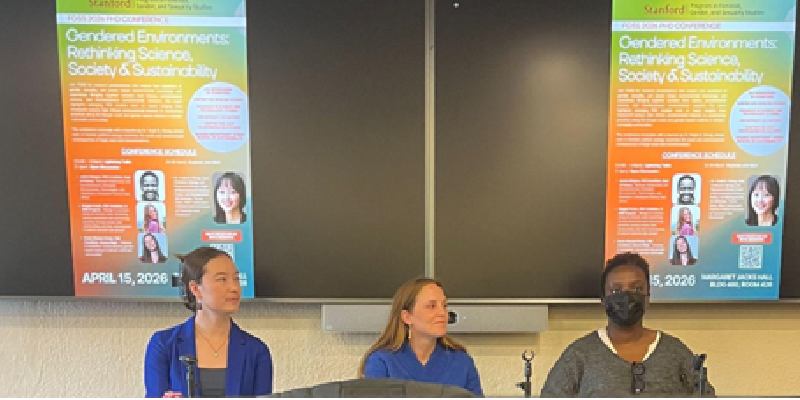
Specialization may be a thing of the past at Stanford University, at least for those trying to solve today’s most complicated issues. Though some fields still maintain clear disciplinary boundaries, many social science and humanities departments have found both intellectual and practical value in exploring cross-discipline solutions to complex, real-world problems. This value was made clear at the second annual Feminist, Gender, and Sexuality Studies (FGSS) Conference where three Stanford doctoral candidates in the FGSS Ph.D. minor shared their current research. “The sciences and engineering are absolutely gendered,” said Stanford Center for Just Environmental Futures managing director Ayodele Thomas in opening remarks. Bringing multiple areas of study together, like FGSS and STEM, can provide a fresh perspective to both disciplines, strengthening research and impact, the organizers said.
Stanford’s position as an elite research institution gives its researchers the ability to investigate real-world problems and lead pathways for solutions. However, real-world problems, like climate change, threats to global health, and gender-based struggles, are becoming increasingly complex and interconnected, requiring researchers to re-examine what it means to search for solutions.
As a Ph.D. student in the Oceans Department, Parker’s research directly integrates both environmental and gender studies to craft a research approach that questions who holds societal power, and how that affects vulnerability to climate impacts. “Incorporating feminist theory is not just adding gender as a variable,” Parker says, “but explores how gendered climate vulnerabilities are produced.”
The other presenters, Maggie Poulos from the E-IPER environment and resources program and Janice Ndegwa from the History Department, take similar approaches to using feminist theory and gender to engage more deeply in their work. Interdisciplinary study can create new avenues for research, and Ndegwa highlights how she uses gender to read between the lines of historical documents, “lead[ing her] to questions [she] would not have thought about otherwise,” such as how descriptions of women’s clothing can give key information about historic trading patterns and human movement through time.
However, that doesn’t mean combining disciplines is easy work. “It’s really challenging,” says Poulos. “I’m always thinking about what I’m drawing from other departments.” Audience members seemed to understand the effort of doing a Ph.D. minor. Yuerong Xiao, a second year Ph.D. student in Earth Systems Science, shares that she attended the conference “to learn from people who are doing this hard but important interdisciplinary work.”
Despite the challenge, many departments at Stanford intertwine with others to create ever growing combinations of majors, minors, and Ph.D. programs. As these threads come together, Stanford students are weaving new solutions to global problems, one knot at a time.