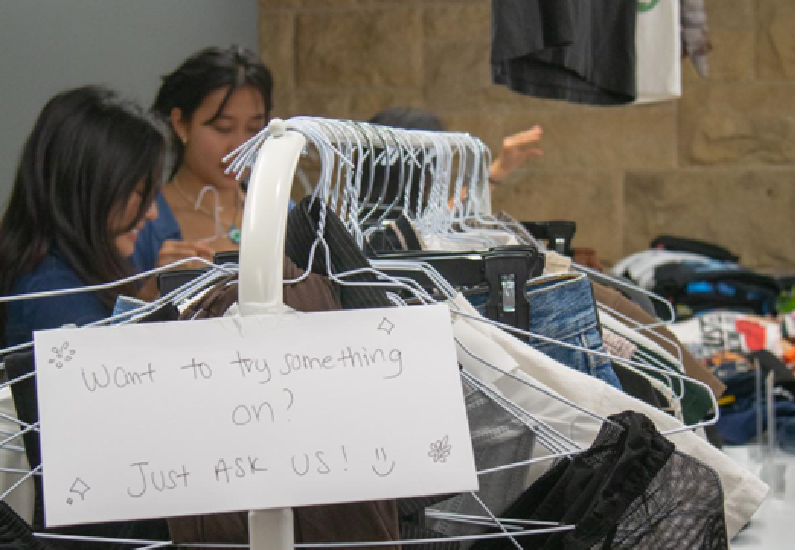
Is 2000’s fashion trending? A quick internet search says yes. Temu, Shein, and other fast fashion companies teem with Y2K themed clothing options. Though these low-cost garment retailers are a gateway to trendy wardrobes, their manufacturing processes bring carbon emissions, pollution, and other environmental costs. Earth Summit, a two-day conference hosted by sustainable budgeting app Commons and online consignment store ThredUp, highlighted a wallet- and planet-friendly alternative to buying new: thrifting.
Held at ThredUp’s Oakland headquarters, Earth Summit opened Monday, April 20 and featured a clothing swap, sustainability-themed art exhibitions, and panel discussions. Every facet of the event circled back to people’s role in the circular economy — a theoretical system which keeps materials and products in circulation as long as possible rather than sending them to landfills or generating more waste.
Earth Summit’s final panel discussed personal finance and featured Sanchali Pal, Commons founder and CEO, and Berna Anat, financial educator and influencer. Moderated by Washington Post climate columnist Michael Coren, the discussion explored the impact of “money stories” — formative experiences that shape people’s personal finance practices — on individuals’ participation in circularity.
Anat shared a personal money story, recounting her grandmother in the Philippines taking apart dresses to reuse the material each year on her mother’s birthday. “She was the original circularity queen,” said Anat, laughing.
This annual reuse of materials pushed Anat’s mother to shop new rather than carry on the tradition after immigrating to the United States. Upon realizing her mother’s intense purchasing habits were a reaction to her grandmother’s circumstantially induced circularity, Anat saw her mother in a different light. “…[U]nderstanding…her money story…made me feel a lot of financial empathy for her and her choices,” said Anat. Rather than shame others for buying new, Anat and Pal advocated for integrating circular practices in ways that work for a person’s lifestyle.
Earth Summit aimed to make circularity’s positive impacts clear while also making circular processes fun and communal. The clothing swap, for example, asked guests to attach their favorite memory of an article of clothing to it before swapping. “You’ll get someone else’s clothes and their memory as well, which I think is really cute,” said Pal to Peninsula Press. Thrifting and circular practices can be really intimidating to newcomers, Pal admitted. “What we wanted to do is just make it easy.”
A fashion focus may seem odd for a sustainability summit, but clothing manufacturing has a massive impact on environmental health. Producing one cotton t-shirt requires 700 gallons of water, while a pair of jeans requires 2,000 gallons, a Business Insider article found. Giving clothing a second life prevents restarting the waste-generating process to create its replacement.
Thrifting, a glimmer of hope in making fashion sustainable, seems to be rising. Buying secondhand has grown 143.5% in terms of market value according to Capital One Shopping Research. Environmental impact is evident: according to ThredUp, thrifting through them has avoided 673 million pounds of climate warming emissions.
Fashion trends rise and fall, but circular practices persist. For Pal, Earth Summit was about helping attendees recognize circularity around them. “It’s both having the practical elements of what’s here today and what’s accessible to me now,” said Pal, “and also the courage and the space to dream about what could be here in the near future.”