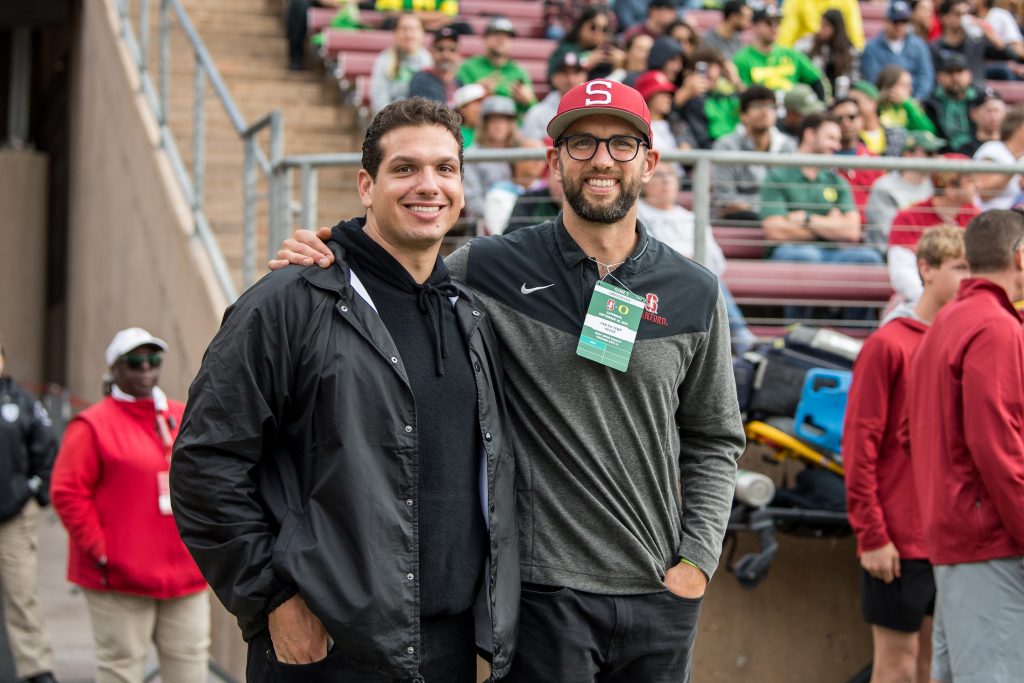
Every summer before the NFL season begins, former Stanford football captain Sam Schwartzstein reads “The Hidden Game of Football” — a seminal book from 1988 that pioneered football analytics — to remind himself how far sports data has come.
“Stats are things you can see,” he said. Analytics, he added, are “the statistics that you cannot see just with your naked eye.”
In Schwartzstein’s role as an analytics expert for Prime Video, he helps bring the unseen to the masses on Amazon’s weekly presentation of “Thursday Night Football.”
“I help build [artificial intelligence] models so that ultimately you get new information on your screen,” he said.
Schwartzstein is also a key figure behind “Prime Vision With Next Gen Stats,” an alternate broadcast of the game that aims to turn viewers into smarter sports fans. It features real-time data overlays that illustrate advanced statistics such as how long the quarterback takes to throw, as well as AI-driven predictive alerts for what will happen next that are powered by the models Schwartzstein and his team help develop.
During the NFL season, Schwartzstein travels from his home in San Mateo, Calif., to Amazon MGM Studios in Culver City, Calif., from Wednesday to Friday for each week’s production of “Prime Vision With Next Gen Stats.”
“Thursday Night Football” averaged 15.3 million viewers per game during the 2025 NFL season, making it the most-watched season in the show’s 20-year history. “Prime Vision With Next Gen Stats” acts as an incubator, developing features that will one day become clear enough for general audiences to be shown during the main broadcast, he said.
At Stanford, Schwartzstein was a center who protected quarterbacks Andrew Luck, Josh Nunes and Kevin Hogan. (“I still get introduced as Andrew Luck’s center,” he said.) The Cardinal finished 12-2 during the 2012 season when Schwartzstein was a senior, winning the Pac-12 championship and the Rose Bowl.
One of his Stanford teammates, Richard Sherman, is his Amazon teammate now, as an analyst for Amazon’s pregame, halftime and postgame coverage on Thursday nights. “I think Richard is one of the best leaders I’ve ever been around,” Schwartzstein said, adding, “When Richard was on the team at Stanford, he thought he was the best defensive back in the world. Not a lot of people thought that. Turns out he was right.”
As an offensive lineman, Schwartzstein entered the 2013 NFL Draft but went undrafted. Instead of being on the field in the NFL as he’d hoped after graduating, he found himself working at an education technology company.
“When you’re a former football player, you win the Rose Bowl and your next job is in accounts receivable, you don’t think you’ll do anything [high profile] again,” Schwartzstein recalled thinking at the time.
He first found his way back to football in 2018 when he was tasked with leading strategy and innovation for the XFL’s Football Operations department. In 2024, the NFL adopted the dynamic kickoff rule inspired by the XFL kickoff Schwartzstein refined through more than 1,000 data simulations. The format lines up both teams yards apart and keeps everyone except the kicker and returners from moving until the ball is caught or hits the ground, a design meant to reduce high-speed collisions while bringing back kick returns. The league made it permanent in 2025.
Schwartzstein studied science, technology and society at Stanford before earning a master’s degree in communication and media studies in 2013.
“Very few people get to … use what they did in college in their professional work,” he said.
He joined Prime Video in 2022 and said he believes there is one Stanford class that perfectly prepared him for the opportunity.
A decade earlier, R.B. Brenner showed his Digital Journalism class The New York Times’ “Snow Fall: The Avalanche at Tunnel Creek” — a multimedia feature by reporter John Branch. It changed the way Schwartzstein thought about data storytelling.
Brenner, a lecturer in the Department of Communication, spent three decades working as a reporter and editor. He was one of the primary editors of The Washington Post’s coverage of the Virginia Tech shootings, which won a Pulitzer Prize in 2008.
“I’m glad [Snow Fall] made such an impression on him because it’s truly the idea of technology and multimedia in service of storytelling,” Brenner said.
The class was one of the first at Stanford to introduce the importance of data in journalism. Brenner charged students with thinking about the universe of potential data sources to tell a story.
“You then can try to interrogate it, sort it, ask questions of it, visualize it, and then find stories in it,” Brenner said.
Finding stories in the data is exactly what Schwartzstein does in his role.
“There’s a bunch of if/then statements when you prepare for an opponent in football,” said Andrew Luck, former Pro Bowl NFL quarterback and current general manager of Stanford’s football program. “And Sam, I think, intuitively thought that way.”
Defensive alerts, which are shown on Amazon’s main “Thursday Night Football” broadcast, came from Schwartzstein’s own decision-making on the field. At center, he was constantly evaluating the likelihood that certain defensive players would rush the quarterback he was protecting.
He brought this thinking to his team at Amazon and together they worked to create an AI model that could identify defensive threats in real time. Now, a red circle highlighting these players shares the story with viewers at home.
When it comes to the complex world of football analytics, making sure the audience understands the story with visualizations is half the battle. Colors, timing and the user experience of someone watching the broadcast on mute at a bar are all considered.
Schwartzstein said Brenner is top of mind as he works through these decisions.
“How would R.B. do this? Or how would R.B. push me to think about the limits of what we can show?” Schwartzstein said.
Brenner said he remembers seeing the same leadership and strategic thinking Schwartzstein deployed on the football field at Stanford in his classroom.
“Those qualities that made him such a successful football player [and] leader also made him a really strong student,” Brenner said.
To Schwartzstein, the best part of football each week is when teams do something brand new that he — and the data — didn’t see coming.
“You can’t predict this is the week they’re going to buck the trend, you know?” he said.
Luckily, Brenner’s class prepared him for that too.
“A cool part of learning how to storytell is [that] even when you’re wrong, the data told a story and you told a story,” Schwartzstein added. “The team’s allowed to be the team.”