FERNBRIDGE, Calif. – Last October, Cate Edwards received a text message from a blocked number.
“You need to contact this number,” the message read. “He can help. We need the mill here. It’s his personal phone. I can’t tell you who I am.”
Cate and her husband Shawn had recently moved from Kentucky to open Lost Coast Spinnery in Fernbridge, the first wool mill in Humboldt County in 15 years. Their goal is to revive American-made wool in an area with a dormant, but deep history of sheep production.
“This industry has people like me that think it matters, and they think it’s important and that it needs to be saved,” Cate said.
Cate is one of many wool enthusiasts in Northern California who have chosen to fight back against plastic materials and grow sustainable fiber, regardless of the grim financial outlook. Milling isn’t a lucrative business. Many in California have shut down over the past few decades, but Cate saw a need to fill this void.
“There’s a lot of community here that was desperately looking for a mill,” Cate said.
Before Lost Coast Spinnery, the closest mill to Humboldt was a five-hour drive away. Now that there’s a processor in town, many ranchers are finally realizing their wool’s full potential by transforming it into yarn.
Lost Coast Spinnery operates out of a small building on Fernbridge’s main road. After one month, the electricity started flickering and her machinery shut down.
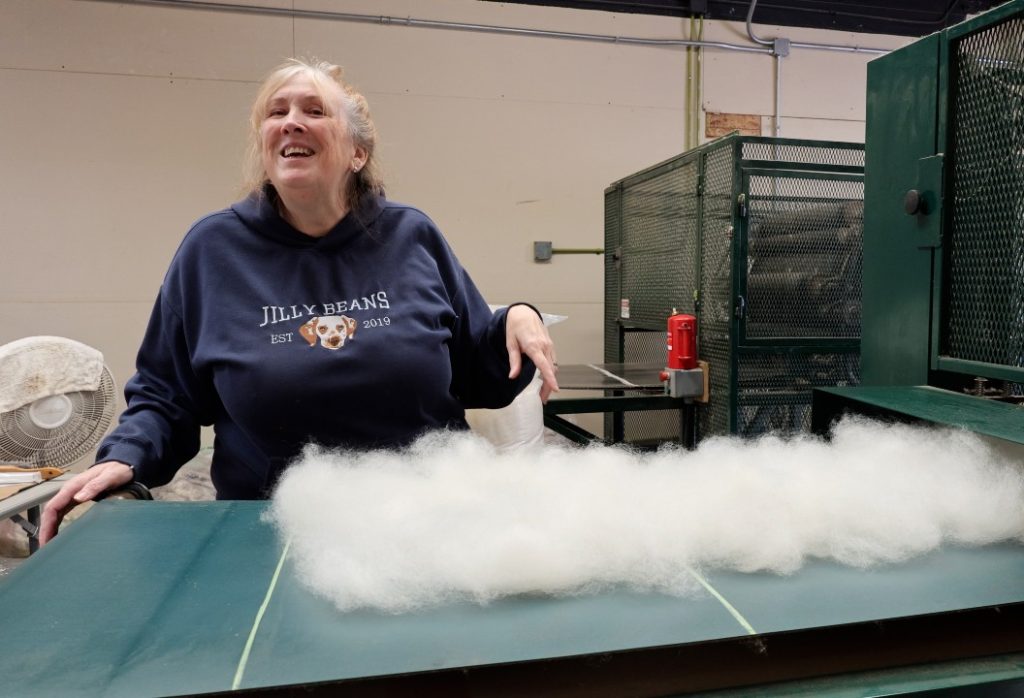
Nine months later, Cate still can’t operate her five machines at the same time. She said they’re losing $1,000 a day without sufficient power to complete the orders stacking up. The spinnery has a six-month waiting list for people who want to buy yarn, according to Cate. Bags of raw wool waiting to be processed have piled up so high, they almost cover the entire floor of the mill.
The Edwards had been searching for other buildings that would meet their power needs, when the community member anonymously sent the personal phone number for Humboldt’s Pacific Gas & Electric regional manager in hopes he could solve their power issues and keep the mill in the area.
Amid the couple’s frantic search to find a new building, a real estate agent approached Cate and said someone was willing to fund the mill’s new building with one stipulation: the space had to be in Trinity County, a three-hour drive from Humboldt.
When word spread the mill might move out of the area, “people here panicked,” Cate said.
The Edwards declined the offer. “We’re part of this community now. This is where we need to be,” Cate said. “This is central to where the majority of the wool used to be processed here. We need to stay and finish what was started.”
Humboldt’s history of wool production
From the late 1800s to the mid twentieth century, Humboldt was a major hub for California wool production. The county’s fog-covered hills along the Eel River were once flooded with hundreds of thousands of sheep.
Their fleeces were locally processed in a large-scale mill in Eureka until synthetic fiber took hold of the textile industry, dampening demand for wool. The mill was forced to shut down in the 1960s, along with countless other manufacturers around the country who struggled to compete with cheap production abroad.
Without local infrastructure to convert fiber into sellable products like blankets or coats, sheep wool lost its value and many ranchers were forced to sell their flocks. If farmers kept their sheep, they’d burn the wool, compost it, or dump it in landfills. The nation’s sheep population declined more than 90 percent over the last century.
California has remained the largest wool producer in the country. However, many ranchers still dispose of their fleeces since there are only about six mills left in the state, many of which have year-long wait lists. There are no commercial mills in California, and it can cost thousands of dollars for farmers to ship fiber to the larger operations in Texas or South Carolina.
“Wool became an unknown and unvalued commodity. But having the mill here, now suddenly the wool is worth more than a plate full of lamb,” Cate said.
Shifting to sheep
Lost Coast Spinnery’s opening has already contributed to increased interest in sheep production.
“I’ve got five new ranches that have popped up because they realize, ‘Oh my God, I can make a ton of money with this yarn,’” Cate said.
Brooke Damonte has lived in Eureka for 25 years and operates a small urban farm of two angora goats and a rabbit who produce soft mohair and angora fiber. She’s a knitter, and after the wool mill opened, decided to add two Shetland sheep..
Damonte said it would have been difficult to start a flock without a local mill. “I don’t know how sustainable it would’ve been. This is just a hobby for me,” Damonte said. “The thought of shipping wool to Seattle or Oregon, or trying to find a ride for my fleece to a mill is a pretty big barrier.”
Cate said her mill gives small local farms and hobbyists the ability to produce wool and still make a profit by removing the prohibitive layer of high shipping costs. “The big people that have, you know, a 10,000 head count, they don’t need us. It’s all these small to mid-size farms that have no place to go,” Cate said.
The future of wool
While hobby flock sizes may seem insignificant compared to the thousands of sheep that used to roam Humboldt’s hills, Cody Nicholson Stratton, a sixth-generation Humboldt farmer, thinks the future of bringing back wool in the United States is in smaller, local flocks working together to process specialty fiber jointly.
Cody and his husband Thomas run the dairy operation Foggy Bottoms Boys. The Nicholson family has been raising cattle on the same land in the Eel River Valley since the 1860s. They diversified into sheep a decade ago and now process about 2,000 pounds of wool into dryer balls, yarn, and woven blankets each year.
Foggy Bottoms Boys collaborates with local goat operation, Brunner Family Farms, and Lost Coast Spinnery to process the farms’ combined fiber into a blended, luxury wool and mohair yarn double the value of a 100% wool skein. The yarn is wildly popular and all 150 hanks are typically sold out within a couple of months.
Damonte agreed that small-scale agricultural production could help cultivate a reliable economy in Humboldt. “If we could make Northern California a wool hub industry, then that represents real opportunity for us. It’s just exciting to think of something so beneficial that isn’t so extractive on our resources and our economy.”
Supporting an agricultural economy
For decades, Humboldt’s reliance on its resource-rich environment has proven economically unsustainable. The county’s boom-and-bust resource cycle in the logging, fishing, gravel, and cannabis sectors have left Humboldt “economically depressed,” Damonte said.
She has young adult children of her own, and said low wages can make it hard for new adults to make it in Humboldt. “It does seem like kind of the best and brightest get swooped up by Portland or the Bay Area,” Damonte said.
Local wool processing can ensure the money generated from local farms is distributed to Humboldt’s economy, Cody said. Increased production could create jobs “where people can grow in those positions and then they don’t have to leave home if they want to stay in Humboldt,” he said. “There’s options to stay here and have professional careers here.”
If Lost Coast Spinnery is able to expand to a larger-scale production, the Edwards could hire six to 10 people within the next year. “We have people waiting for jobs to actually work here,” Cate said.
In the past few months, Cate hired 12 women in rural California communities to knit custom clothing from the mill’s processed wool. Clients can hand-pick yarn from Lost Coast’s selection and pay a hired knitter up to $500 for a custom sweater.
American-made wool “is for somebody who wants to create an heirloom or something that will be really, really appreciated, said Stephanie Hein, owner of Uncommon Threads yarn store. “You get more of a sense of like, oh, this is from a particular place, this is from a particular type of sheep. I might have even met that sheep.”
Artisinal demand
Humboldt has a strong artisanal identity, and its residents are eager for wool that has been locally-processed into yarn or roving for crafting. The university in town operated a fiber program for about 40 years, and the Humboldt Handweavers and Spinners Guild has existed for a decade longer, generating a devoted fiber arts community.
Crystal Estelle Hobs is one of those artisans. She has lived in Loleta for over 50 years, and refers to herself as “newbie” to the area for Humboldt standards. After she took an Intro to Textiles class in junior college, she was hooked on fiber.
Hobs is a hand spinning instructor now and teaches students how to spin wool into yarn on a wheel. When she heard Lost Cost Spinnery had opened, “I was down there within two days to introduce myself,” she said.
“I have 52 years of experience in this, so when I touch and handle stuff, I know what I’m looking for,” Hobs said. “Her yarns are just beautiful. They’re just exquisitely well spun.”
Cate said employees laboriously “pick like little chimpanzees” by hand and use a non-caustic soap to ensure the yarn comes out silky smooth. Many industrial mills use chemicals to burn vegetable matter like leaves or twigs out of fleeces, which is what creates the itchy sensation many people complain of when they wear wool.
“If you put profits above all else, you’re going to use the harsher soaps,” Cate said. “You’re gonna use carbonization that burns out the vegetable matter and your wool’s not gonna be as nice.”
Humboldt crafters value high-quality fiber, and Cody said many farmers have been disconnected from the fiber artisans in the community. “They don’t understand that there’s this whole market for local yarn that they could be tapping into.”
Cate’s goal is for her spinnery to act as a middleman, connecting wool producers with consumers. She calls her mill “Grand Central Station,” because it brings together people who “never in a million years would’ve met each other.”
In August, a hardcore rancher, sporting 20-year-old Carhartt jeans walked into Lost Coast Spinnery, spitting tobacco on the floor and hauling in massive bags of wool over his shoulder. When yarn shoppers saw his stash of fiber, they “lost their minds,” Cate said.
The women started listing sheep breeds the farmer could acquire to create unique fiber blends. In the rancher’s eyes, the wool had been a “waste byproduct.” For these women, it was “gold that hadn’t been polished,” Cate said.
Lost Coast Spinnery gives artisans consistent access to Humboldt sheep farmers’ fiber. Previously, spinners, weavers, and knitters could only purchase fleece or yarn directly from local sheep ranchers during the annual county fiber fair. These farmers had either hand spun their wool or sent it to a mill in another county or state. With the mill in town, crafters can stop by to purchase local yarn anytime.
Hobs had used wool from New Zealand in her spinning, weaving, and knitting classes for years. Now, she’s happy she can use Humboldt fiber.
“We want our local product,” Hobs said. “We want to support our local people. We want them to thrive and succeed.”
Despite Lost Coast Spinnery’s electrical troubles, Hobs, along with other Humboldt residents, will continue to be able to buy locally sourced wool. After nearly a year of operating at reduced capacity, Cate and Edwards have finally planned to move to a new, much larger building in Fortuna – one that can accommodate three spinning lines, and thousands of more pounds of wool.