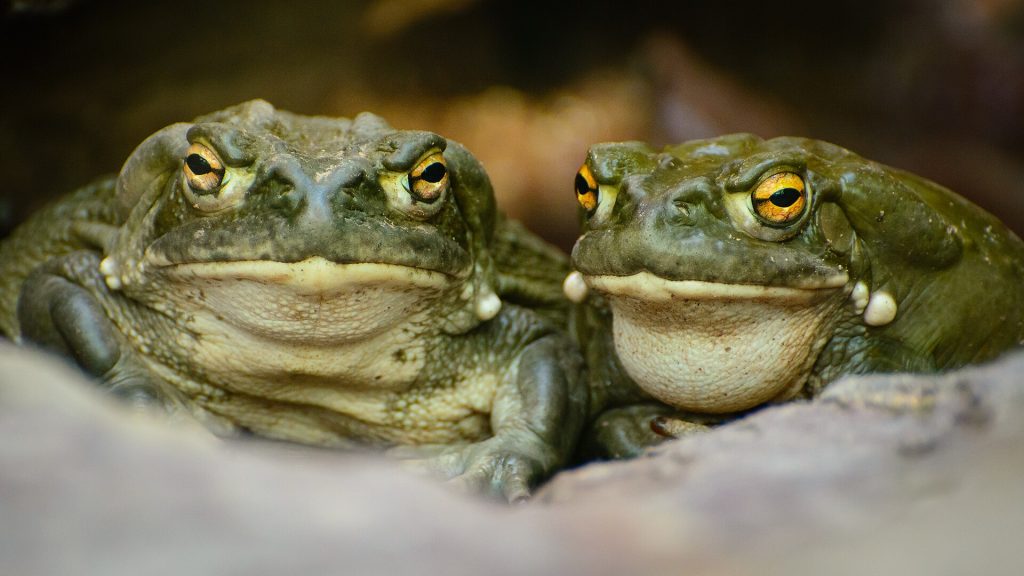
Photo: Kuhnmi, CC BY 2.0, via Wikimedia Commons.
Squeeze a Sonoran Desert toad between your palms and a milky substance will ooze from its glands. Dried, then smoked, the juice is known to cause auditory and visual hallucinations. But poachers, in search of these transcendental toads, have descended into the night on the desert landscape, leading many to worry that the toad will go regionally extinct.
To the amphibians’ presumptive delight, researchers from Israel’s Weizmann Institute of Science have engineered a tobacco plant able to produce five natural constituents of psychedelics, including DMT (present in ayahuasca), and psilocybin (found in “magic” mushrooms), and the active ingredient in the desert toad’s own psychoactive secretions. The development, published in Science Advances, could reshape how researchers, doctors and even amateur enthusiasts access these compounds, potentially helping protect the species that naturally produce them.
Increased interest in treating psychiatric conditions with psychedelics, along with spiritual and recreational uses, has put pressure on ecosystems where these compounds are harvested. Ayahuasca production in the Brazilian Amazon has been linked to deforestation and Sonoran Desert toad populations are falling in Arizona. The five-drug tobacco plant offers a lab-grown substitute. “This is a sustainable way to produce what could be the future drug for mental health diseases,” said Weizmann plant biologist Asaph Aharoni, who led the research team.
The scientists first identified two enzymes that naturally produce DMT, a popular psychedelic. Through a feat of bioengineering, they found that, given the right ingredients, those same enzymes could build the psychoactive components of magic mushrooms, ayahuasca, and the Sonoran Desert toad. A total of These five active compounds were expressed in the leaf of the plant, through a process called biofiltration. The scientists hope their process can streamline production in an ecologically responsible way.
“This approach can potentially reduce the need for separate cultivation and extraction processes, possibly lowering environmental impact,” the researchers write. This could become even more relevant as the psychedelic industry grows.
“There’s a really big push towards the commercialization of a lot of psychedelic compounds,” says Dr. Tess Veuthey, a medical fellow at the University of California, San Francisco, who researches psychedelic medicine to treat psychiatric conditions. But, despite being excited about the prospect, Veuthey noted that the work has a long way to go. “It’s still extremely early days. We still don’t know whether or not [growing psychedelics in plants] is going to be either commercially viable or actually medically useful.”
Still, the proof of concept is striking, and for conservationists in the American Southwest, this promising signal cannot come soon enough. “Any time that a species or population disappears from a piece of land, it disturbs the natural equilibrium that exists,” says Robert Villa, president of the Tucson Herpetological Society. Although the research is still in development, it opens a door to a future where sought-after compounds are grown in a leaf, and the plants, fungi and toads that produce them are left in that natural equilibrium, un-squeezed.
This article was reported and written and edited by Claire Barber, Charlotte Burks, Megan Chen, Zora Hudson, Eleanor Jackson, Isaac Nehring, Sophia Sanders, Rowan Schnebly, Serena Turner and Daniel Verdi, as part of the class EARTHSYS/COMM 177C/277C Science and Environmental Journalism at Stanford University.