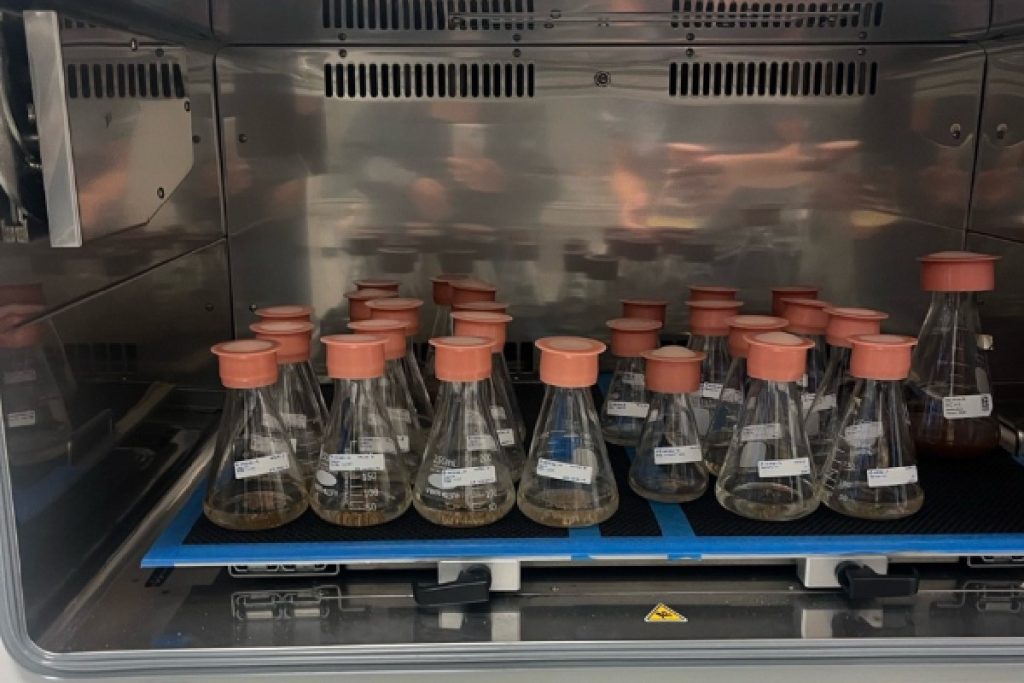
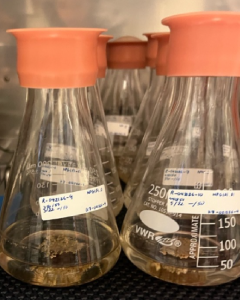
On the boundary of a West Sacramento industrial strip and some of the most fertile farmland in America, twenty glass flasks sit in rows inside a steel incubator, each plugged with an orange stopper and swirling with a cloudy liquid labeled with blue tape. There are no trees, no humid heat, and no soil, yet something tropical is growing. That something is cacao, and the company of food scientists growing it believe that the crop that has defined chocolate for centuries, no longer needs these things.
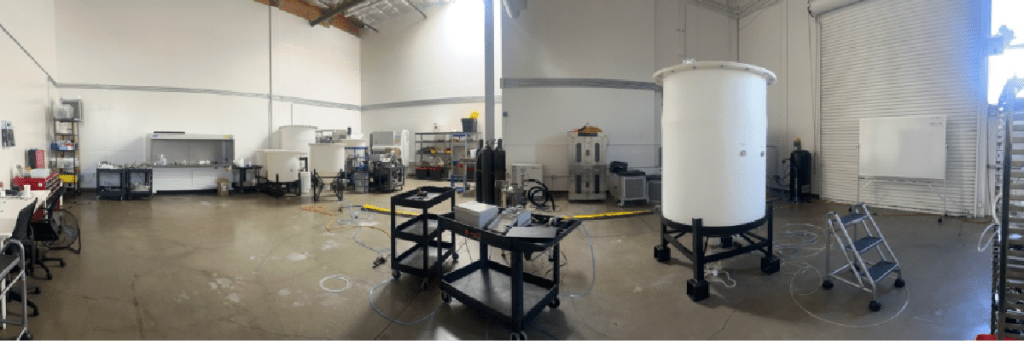
This is California Cultured: a long communal table extends across the middle of the open floor where the team works, a rack of branded merch sits by the door, and an enormous “Chocolate and Cacao Flavor Profile Map” (a wheel of tasting notes running from honey and almond at the center out to cranberry, jasmine, and loam) hangs on the wall. Behind a set of doors is the lab where the actual science happens, and behind that, a bare-concrete garage where a 1,600-liter plastic bioreactor waits, not yet working.
Climate change has already pushed cacao-growing regions into strife and will only worsen. A new wave of startups – backed by some of the biggest names in the chocolate industry – are racing to grow the crop from plant cells inside bioreactors rather than on farms. The maker of Cadbury has supported one such company, Lindt another, and Puratos, one of the world’s largest chocolate ingredient suppliers, has partnered with California Cultured directly, targeting expansion into U.S. shelves by 2027. If there were once questions about whether lab-grown cacao was possible, they are no longer. The riper question now is how we will adjust to its arrival.
A crop on the edge
Cacao trees are one of the most environmentally sensitive crops on the planet. They grow in a narrow band known as the “Cocoa Belt,” which is located within 20 degrees north and south of the equator, where a precise combination of rainfall, temperature, and humidity, creates the only conditions on earth where the cacao tree can thrive. The crop originated in the Amazon basin, but today West African countries supply over 80% of the world’s cacao and nearly all the beans used for “bulk” chocolate – the kind produced for candy bars and commercial chocolate (often containing added sugars, artificial flavors, and more ingredients), as opposed to craft or fine chocolate, which relies on minimal ingredients and is used high end products like pastries and truffles.
But the cocoa belt is shrinking. Cacao trees are becoming exposed to increasingly high temperatures, which makes them close the tiny pores on their leaves to prevent drying out, halting carbon dioxide uptake and starving the plant. Additionally, increasingly erratic weather patterns produce flash floods, which submerge plantations and rot roots, followed by prolonged droughts that cause beans to wither. A 2018 study from the National Oceanic and Atmospheric Administration projected that rising temperatures could render over half of West Africa’s cacao-friendly regions unsuitable for cultivation by 2050.
For consumers and producers alike, the effects of this are evident. In 2024, cacao prices hit record highs, exceeding $12,000 per metric ton. As a result, the price of chocolate bars increased by roughly 20%, while average bar sizes fell. It is little surprise, then, that Big Cocoa is looking for alternatives, with Cadbury investing $5 million and Lindt investing $6 million into lab-grown ventures such as Celleste Bio and FoodBrewer respectively.
California Cultured enables chocolate without a farm
Alan Perlstein has spent his career growing natural things unnaturally. After earning a degree in biotechnology from Columbia University, Perlstein found himself working in a cell-cultured fish lab on Long Island, learning how to grow fish meat from fish cells instead of farms. Shortly thereafter, he founded Joywell Foods (formerly known as Miraculex), a company that used cell culture to produce protein-based sweeteners. After deciding to turn his attention to cacao, he recruited the world’s leading cocoa cell expert, Harrison Yoon, who brought three decades of plant cell culture experience with him. Together, they built California Culture as a sustainable alternative to farm-grown cacao that could supplement the global supply.
Then, in 2024, Steven Lang joined the company as VP of Science and Technology, having previously run cell culture operations at Upside Foods, a food technology company that produces cultivated meat directly from animal cells.
In a food science world that routinely spotlights making cultivated meat to save the environment, Lang realized that plant cell culture could have an even bigger impact on the environment than its animal counterpart. He describes the science of California Cultured in relatively simple terms.
“Think of it very much like a smoothie,” Lang says. “You put liquid, like a milk, into a blender, add your different ingredients – and our cells are essentially the ingredients – then turn on the blender and everything gets mixed. Except we’re not just mixing them, we’re aerating them to get their metabolisms to work and grow.”
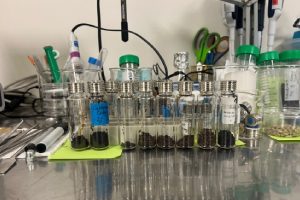
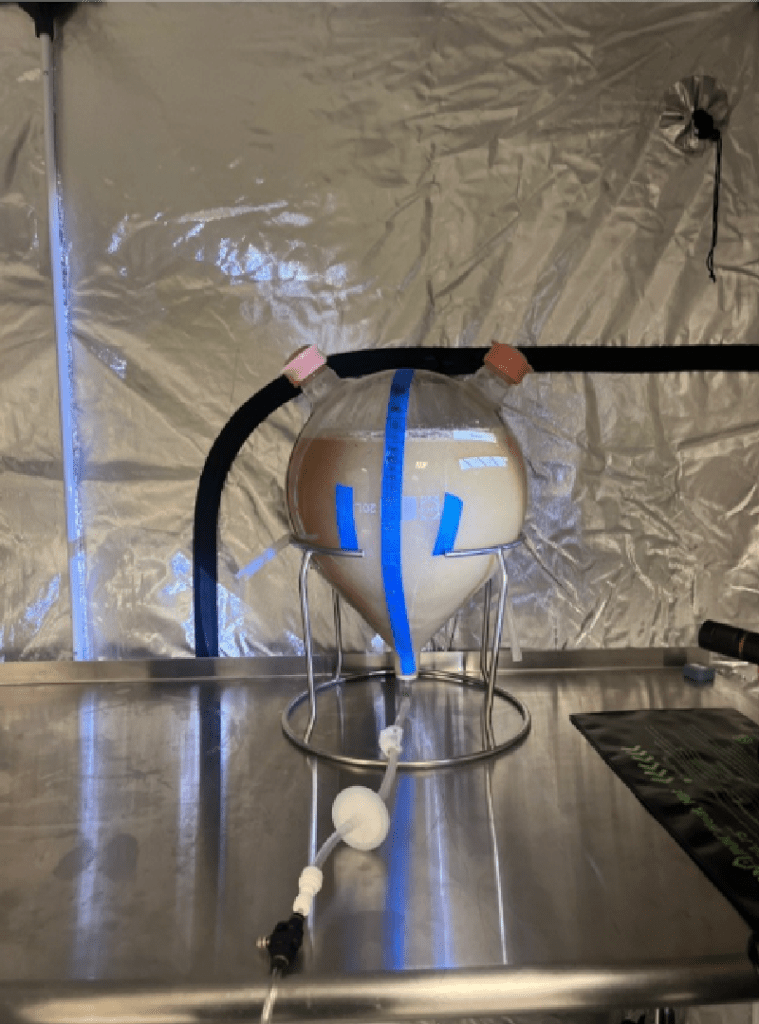
More technically, California Cultured extracts cells from a cacao bean, screens them for desirable traits like rapid growth and high flavanol content, then cultivates the strongest cell lines in bioreactors. Their bioreactors are plastic, as those are significantly cheaper to operate than the stainless-steel tanks used in animal cell culture. The cells are fed a mineral and carbohydrate-rich nutrient broth laced with natural plant signaling molecules and divide and reproduce until harvest. Unlike growing an entire tree, which can take years to bear fruit and collapse under shaky conditions, this entire process takes days.
The result? A powdered product reminiscent of traditional cocoa powder. It can be used in a variety of ways and, according to Lang, contains additional health benefits that its natural counterpart lacks. While conventional chocolate products contain toxic metals such as lead and cadmium, which can be harmful for developing neurological systems. California Cultured’s product avoids this.
“We’re able to control the raw materials going into our bioreactor and limit the amount of heavy metals down to near zero [in our cocoa powder], which is unheard of,” Lang explains. From a nutritional standpoint, the powder is nearly identical, with the biggest difference coming from the profile of flavanols, antioxidants found in cocoa beans that effect both flavor and health benefits. Now that California Cultured has mastered their formula, their next step is stocking shelves with their cocoa, which is slated to occur in mid-2027, when Puratos plans to become one of the first companies on the market with a cell-cultivated chocolate product.
Despite the promise, the reception from chocolatiers and consumers remains uncertain. Timothy Woods, co-founder and chocolatier of Timothy Adams Chocolates, is one such skeptic.
Asked whether he would ever use lab-grown cacao, Adams was unsure. “I just love things that come from the land, from the earth, and nature,” he said. “So it just feels like you’re taking the romance out of it.”
What is the price of progress?
Lab-grown cacao promises a future where crops are no longer at the mercy of the natural environment. Sooner than later, this future will likely be commercially viable, as California Cultured recently demonstrated proof of concept in 1,600-liter bioreactors. Even still, fundamental questions persist as researchers work to fully characterize the sensory properties of cultured plant cells (no independent testing has confirmed the equivalence between cell-cultured and conventional beans yet) and implement commercially viable technology.
Consumer acceptance is another large predicament. Lang recognizes this challenge: the cellular agriculture space has been tainted by backlash against cultivated meat. “Consumer acceptance is very low… in surveys done of consumer acceptance of novel foods, people would almost rather eat insects than cultivated meat.”
However, it is important to recognize that lab-grown meat and lab-grown plants are entirely distinct. To that end, he is co-authoring a paper with researchers at Tufts, Texas A&M, and UC Davis arguing that plant cell culture deserves to be understood on its own terms. For Lang, people already intuitively grasp the basic idea: schoolchildren learn that a cutting from a plant can grow into an entirely new one, and we routinely process corn and soybeans into products, some not even food, like ethanol. Cocoa, for Lang, is simply the next step in an already familiar journey. “The hurdles to getting consumer understanding of cell culture products is going to be a lot easier by focusing on plant cell culture products like cocoa, rather than the far-reaching vision of cultivated meat, where we’re printing steaks for people.”
The difference may also be visceral. A slab of muscle tissue grown in a vat is presented to diners as the centerpiece of the meal. On the other hand, cultured cocoa arrives as an ingredient, a powder folded invisibly into chocolate.
Finally, there is the question of who else this technology benefits. The cacao supply chain is wrought with labor issues. “There’s a lot of slave labor and child labor and [West Africa], is where the really intense labor practices happen,” Timothy explains. Even still, over five million farmers (predominantly located in West Africa, Latin America and Southeast Asia) depend on cacao for their livelihoods. If lab-grown cacao scales to meet even a fraction of global demand, those communities could face economic death. For California Cultured, however, this is not a realistic scenario. They are not attempting to replace jobs but simply fill in gaps. “Our population is growing and the amount of land suitable for farming is diminishing — we’re going to have a gap that will lead to starvation unless new technology helps us fill it,” Lang says. The farmers will “continue to grow cocoa as best they can, but we just hope to be able to fulfill some of the gaps in the supply chain with our material.”
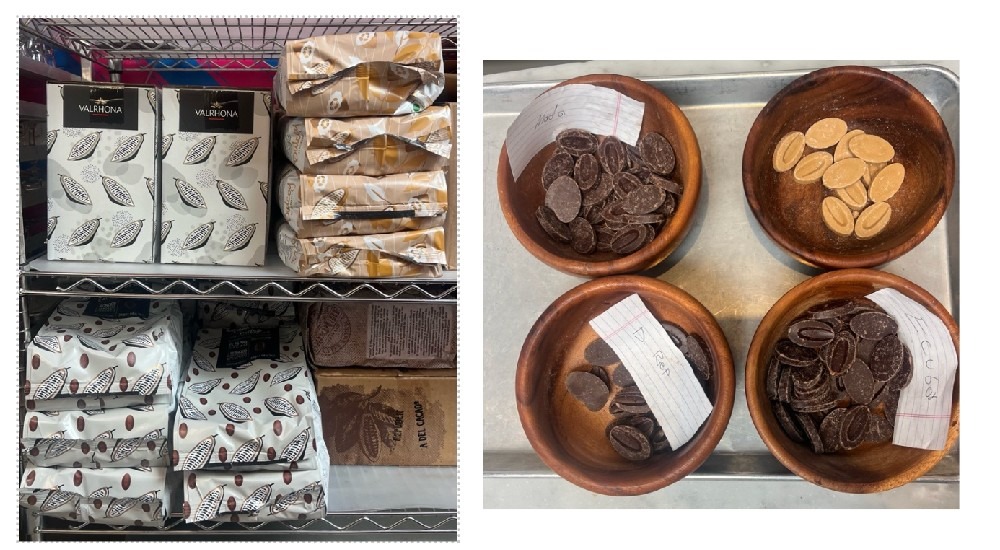
For consumers, serious questions compile quickly. As people remain increasingly wary of what they put in their bodies, questions about what exactly they are eating, who decided it was safe, and whether a product born from a steel vessel compares to one born from Ghanaian soil will undoubtedly take center stage.
But for now, the cells continue dividing quietly in West Sacramento, defying nature to birth a crop that has never once been kissed by a tropical sun. Whether they are growing a viable future for chocolate, a temporary craze, or a solution for a desperate industry remains an open question. And the answer, like the chocolate itself, is still taking shape.