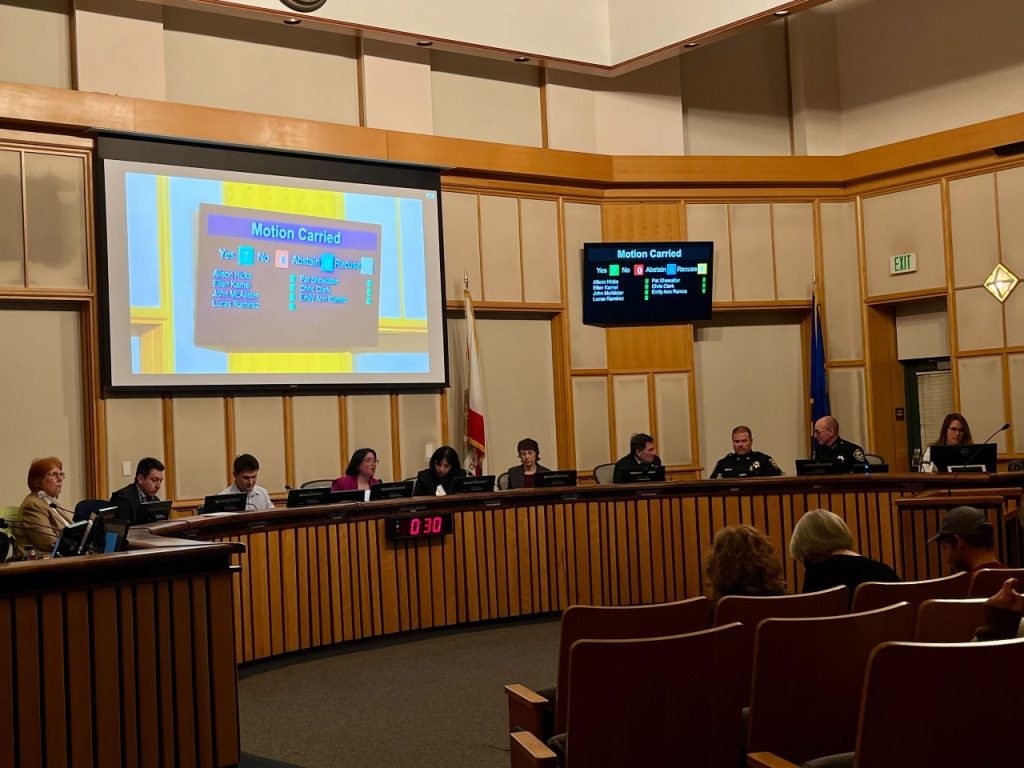
MOUNTAIN VIEW, Calif. — The Mountain View City Council voted unanimously on Tuesday, Feb. 24, to terminate its contract with Flock Safety after the police department discovered that outside agencies — including Bureau of Alcohol, Tobacco, Firearms and Explosives offices in Kentucky and Nashville and Langley Air Force Base in Virginia — had accessed the city’s license plate camera data without authorization.
Mountain View joins a growing number of California cities pulling back from Flock Safety. Santa Cruz voted in January to end its contract with the company on Jan. 13 and became the first city in California to do so. Two days later, on Jan. 15, Los Altos Hills also terminated its agreement.
Mountain View launched the automated license plate reader (ALPR) pilot program in mid-2024 and authorized a one-year contract with Flock Safety worth up to $96,800. The system uses pole-mounted cameras to photograph passing vehicles, referencing that data against “hot lists” of vehicles linked to crimes or missing persons and generating real-time alerts to officers when a match is detected.
Cameras Off, Trust Broken
Police Chief Michael Canfield and Capt. Evan Crowl presented to the council, walking through the department’s use of the system and how they discovered that external agencies had been accessing Mountain View’s camera data without the city’s knowledge.
Canfield said the department built the pilot program with strict privacy protections in mind: no out-of-state data sharing, no immigration enforcement use and required approvals before any outside agency could access Mountain View’s camera data. None of that, it turned out, was guaranteed by the system Flock had set up.
In a recent audit, the department discovered a “National Lookup” and a “Statewide Lookup” function had been enabled in the system from the start, allowing agencies to search Mountain View’s license plate data without authorization. All 30 ALPR cameras in the city were shut down on Feb. 2 after the audit.
According to a statement by the city on Jan. 30, the national lookup setting, which enabled access by agencies outside California, was enabled on the city’s first camera from August to November 2024.
“We did not know this was going on. We had not set it up and we were surprised to learn of it,” Canfield told the council. “When we pressed Flock about how it could have happened, they told us that they no longer had records for how the system was turned on or how it was turned off.”
Flock Safety later corrected the wrong settings, first disabling the national lookup feature for Mountain View in November 2024, and then turning it off for all California agencies in early 2025, Canfield said. But a lack of transparency continued: the company never notified the department when it changed the settings.
“Notably, staff have since learned that both the nationwide and statewide interfaces were enabled for many other agencies that were also unaware of them,” according to the police department’s report to the council. “MVPD is not an outlier in this regard.”
“Flock representatives in private conversations have been pretty blunt about their failures,” Canfield said. “ I think they have absolutely failed to perform in the way in which they assured us that they would.”
Despite recommending termination, both Canfield and Crowl acknowledged the technology had delivered results. Between August 2024 and December 2025, MVPD conducted approximately 24,743 searches in the license plate reader system. In 2025, the cameras generated 794 custom hotlist alerts, 233 stolen vehicle alerts and 51 felony vehicle alerts.
That data contributed to investigative leads or helped solve more than 200 cases and resulted in at least 41 suspects identified or arrested. Crowl highlighted several cases, including the arrest of a domestic violence carjacking suspect tracked into San Francisco, the rescue of a kidnapping victim and the dismantling of a mail theft ring spanning six counties and affecting more than 588 victims.
Community Pushback
Yet for many residents, the system’s investigative value has come at too high a price. The question was about what mass surveillance makes possible in the wrong hands.
Public comment ran for about an hour and a half. Speakers urged the council not just to end the Flock Safety contract, but to reject all future ALPR technology, seek reimbursement from Flock Safety and file a class action lawsuit against the company for violating California’s sanctuary law.
“The issue is not with the city’s meaningful work to protect us, but our issue is with Flock and with all ALPR vendors. The technology itself is the problem,” said Tim McKenzie, speaking on behalf of Silicon Valley Democratic Socialists of America. “Flock’s lie by omission is what caused this breach in our data and broke our residents’ trust.”
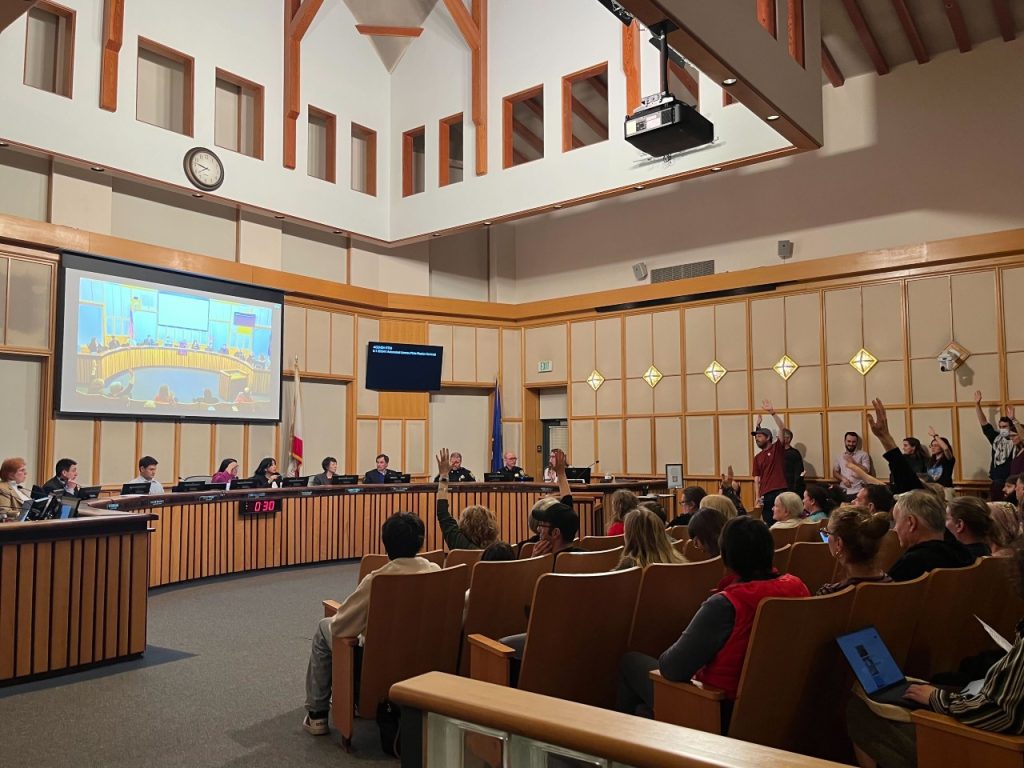
Multiple speakers connected the cameras directly to fears about immigration enforcement under the current federal administration. A CalMatters investigation last June found that law enforcement agencies across Southern California violated state law more than 100 times in a single month by sharing license plate reader data with federal agents, including Immigration and Customs Enforcement (ICE) and Customs and Border Protection (CBP).
“When the federal government has given ICE and CBP authorization to discriminately arrest our people based on the color of their skin or their accent, and break down doors without warrants,” said Melissa Dinwiddie, a Mountain View resident of 23 years and the founder of Indivisible Palo Alto Plus. “We must protect our immigrant communities who have built our vibrant, bustling and diverse city of Mountain View.”
“A lot of people in the county are really concerned about what ICE and surveillance technology has been doing across the country,” said Mariya Genzel, leader of It’s Blue Turn Indivisible. “We were gratified to see that people in Mountain View and the government are taking this seriously, including the police, which often can be on the other side of civil liberties. “
Voices From the Dais
Several council members shared personal remarks before the vote that underscored how the issue extends beyond the vendor to questions of civil liberties and community trust.
Council member Ellen Kamei, who made the motion to terminate the contract, invoked the anniversary of Executive Order 9066, which led to the forced incarceration of more than 120,000 Japanese Americans during World War II.
“No Japanese Americans were ever charged or convicted of espionage or sabotage, yet they were targeted and imprisoned simply for having a face that didn’t look like everyone else’s,” Kamei said. “I believe this history reminds us of what can happen when civil liberties are overridden and when safeguards fail.”
Mayor Emily Ann Ramos, who seconded Kamei’s motion, spoke of carrying a passport card at all times since 2016, even though she was born in the United States, and described growing up with her parents’ stories of living under martial law in the Philippines.
“I felt like I needed that safety blanket to show I belonged in case I would get picked up in the street,” Ramos said. “It is suffocating how terrifying it is for our community now.”
Council member McAllister supported the motion but also urged residents to maintain trust in the local police department, drawing a distinction between Flock’s failures and the conduct of MVPD officers, which he said had been consistently professional throughout the pilot.
The motion passed unanimously. City staff indicated they would work with Flock on a timeline for camera removal, though no estimate was provided. Ramos asked that the community be notified once all cameras are physically taken down. Staff will also evaluate potential reimbursement of fees tied to the remaining contract term.“Public safety must be grounded in community trust, and after hearing significant feedback from residents, the Council determined that this program does not best reflect our community’s priorities,” Ramos said in a statement following the meeting. “We are grateful to those who took the time to share their perspectives.”
(Correction: A previous version of this story misspelled the name of Melissa Dinwiddie. This story has been updated.)