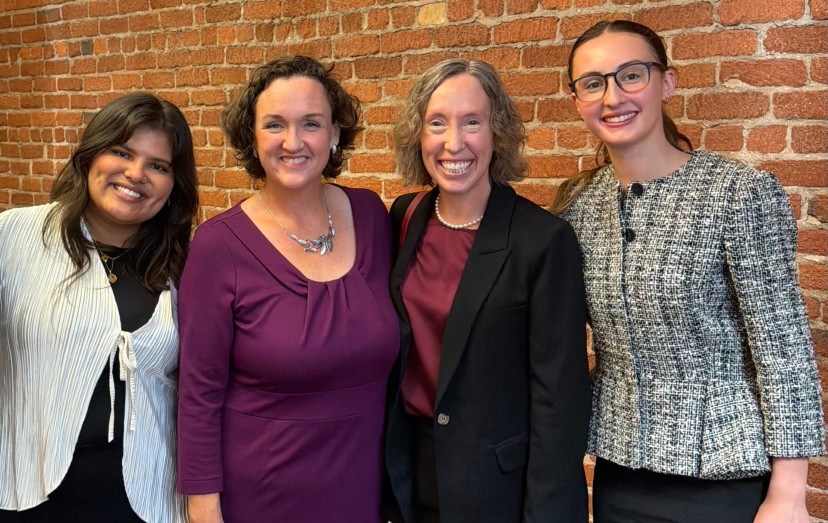
SAN FRANCISCO – A slate of women running for state office emphasized the importance of women’s political representation to a crowded ballroom of donors in San Francisco’s financial district on Jan. 30.
Among the speakers were two gubernatorial candidates: former U.S. representative Katie Porter from California, and Deb Haaland, former U.S. representative and secretary of the interior from New Mexico.
The luncheon was hosted by Fund Her, the only political action committee (PAC) to fundraise exclusively for progressive women running for local and statewide office. When the organization launched in 2017, California’s legislature was 22% women. Today it’s 49%, standing one woman away from becoming the first top five global economy to reach gender parity.
Since its founding, Fund Her has backed over 100 winning candidates across 8 states, flipping the state legislature in Michigan, Minnesota, and Virginia. More than 69% of these candidates have been women of color or members of the LGBTQ+ community. In 2022, Fund Her helped elect Arizona Governor Katie Hobbs, and just last year backed Abigail Spanberger in her successful bid for Virginia governorship.
For Valerie McGinty, founder and president of Fund Her, electing California’s first woman governor has been a goal since day one. Recalling Fund Her’s launch in the wake of Hillary Clinton’s 2016 presidential loss, McGinty said, “When we started, I said to myself, OK, maybe we can’t put a woman in the White House, but darned if we can’t put a woman at the helm of the world’s sixth largest economy.”
With California now the fourth largest economy, McGinty’s objective hasn’t changed. “Especially for how progressive California thinks it is, the fact that we have not had a woman governor just sticks in my craw,” she said.
It’s been over 30 years since Kathleen Brown won the California Democratic nomination for governor in 1994. “The average Californian was in utero at that point,” remarked Porter in her speech.
California is one of 17 states to never have a woman governor. “We have had movie star governors. We have had governors who were children of governors. We have had governors with slick back hair who look hot in a barn jacket. But we have never had a governor who wears a skirt,” said Porter to great applause.
This isn’t Porter’s first rodeo in breaking political norms. In 2018 she became the first Democrat to occupy California’s 45th district seat in Orange County since its formation in 1983. In her Congressional debut she also became the first single mom elected to the U.S. House of Representatives.
A fellow single mom, Deb Haaland is a trailblazer in her own right. As a 35th generation New Mexican, she would be the first Native American woman elected governor. She currently holds an over 30-point lead over her male competitors in the race for New Mexico’s governor, according to the latest polling data.
Irrespective of these firsts, speakers at the luncheon stressed that female representation and gender parity aren’t just about hitting milestones but paving a path towards more effective governance.
“Women don’t run to be somebody. They run to do something,” McGinty said to the ballroom of donors. On average, women Congressional members bring about 9% more dollars in federal funding back to their districts than their male counterparts, found two researchers from Stanford University and University of Chicago. Congresswomen were additionally found to sponsor and cosponsor more laws than the men from their districts.
In 2026, women represent roughly one-third of state legislators nationwide. “We’re half the population,” said McGinty in an interview. “I should not be governed by a power that does not represent me.”
Speakers at the luncheon also emphasized that women legislate more on issues concerning women, children, and families. Democratic women in particular have been found to introduce—and successfully pass—more bills addressing childcare and sexual harassment, according to a policy analysis released by the National Women’s Law Center and Quorum in 2018. “Midterms are really about rights… women’s rights, LGBTQ rights, you name it,” said Assemblymember Diane Papan (CA-21) who is running for reelection.
The political moment loomed large as, outside, ICE protests swarmed the streets of San Francisco and the nation. “We are here sheltered for a couple hours from the moment that we are in. The painful, challenging moment that our county is in. We are facing the fight of a generation,” said Porter to an attentive room.
The urgency of the January afternoon and the approaching election season were reflected in the day’s numbers. Raising nearly $345,000, the luncheon far surpassed any amount raised at a Fund Her event to date. Haaland received over $44,000, and Porter over $27,000. According to McGinty, the rest will be used to sign mass checks for Fund Her’s next round of endorsements for state legislature.
The PAC has more fundraising events planned for 2026, including a national virtual walkathon beginning March 8, International Women’s Day.
McGinty concluded her brief luncheon remarks by declaring, “When we Fund Her, we change America.”