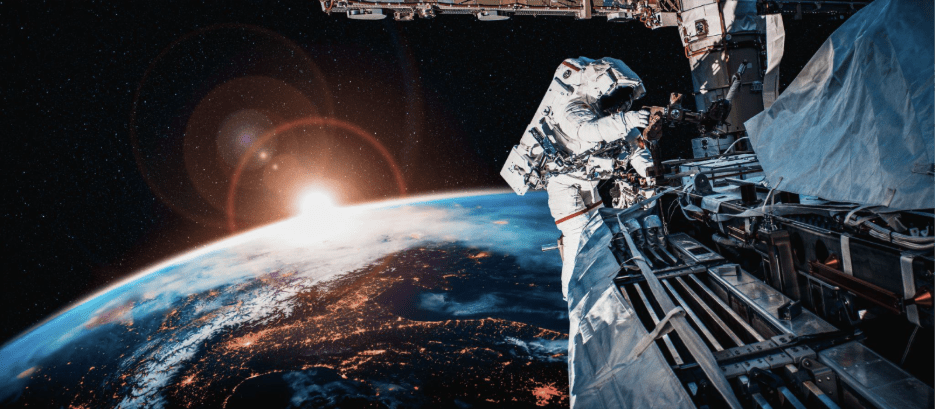
Takeoff in 3, 2, 1
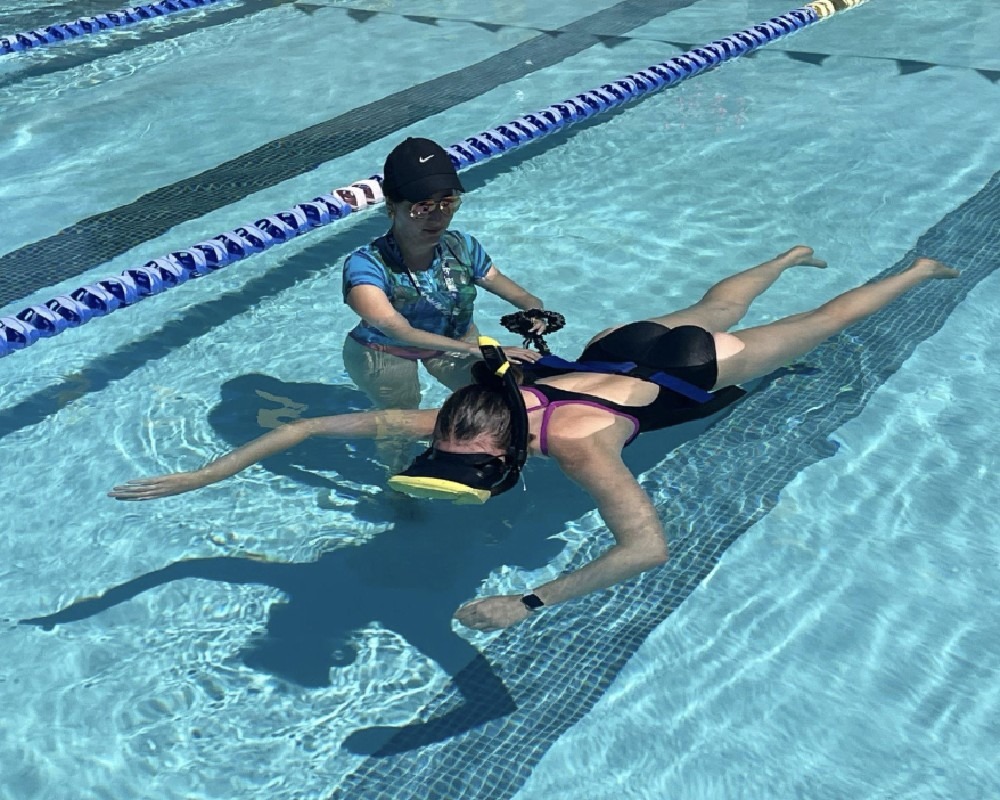
The astronaut’s voice excites me as I float face down in a Stanford swimming pool. My snorkel pokes above the water while a flotation belt strapped around my waist keeps me suspended effortlessly near the surface. Inside the diving mask covering my eyes, I watch as the land – not water – below me gets further away.
You are now 100 km above sea level and officially in space
Looking down, I see Earth illuminated against the darkness of the surrounding void. The astronaut voice points out the northern lights rippling over the poles and the thin blue line of our atmosphere that has sustained all life on earth for millions of years. At one point, I drift past the International Space Station, and as I turn my head to explore, I nearly bump into the station itself.
With a VR display built into my diving mask, I am reminded of the extraordinary place we all share and the tiny pale blue dot encompassing all of life as we know it. For a few moments, it becomes surprisingly easy to forget I am simply floating in a swimming pool.
Researchers at Stanford University are investigating whether immersive virtual reality experiences like this one can recreate the profound psychological shift reported by astronauts viewing Earth from space. Called the “overview effect,” this unique phenomenon is often
described as deeply emotional and even transformative, producing feelings of awe, interconnectedness, and renewed appreciation for the fragility of the planet.
With the recent success around the Artemis II mission to the dark side of the moon, there has been a rise in interest in human spaceflight. Artemis II, NASA’s first crewed lunar flyby in over 50 years, sparked significant widespread public interest as over 27 million U.S. television viewers watched the historic splashdown. During the flight, images of Earth from space were sent back in real time, creating emotional resonance – shaping public connection and environmental awareness.
But while astronauts and, more recently, ultrawealthy space tourists have had the opportunity to experience Earth from orbit firsthand, researchers at Stanford are asking if that same perspective shift can be brought back down to Earth for the rest of us.
The Stanford study, which involved more than 200 participants, is among the first to combine virtual reality (VR) with underwater simulation to create a more physically immersive experience. Participants wear a flotation belt to simulate the weightlessness of space, while breathing through a snorkel and watching a 360-degree VR simulation through a modified diving mask.
“A lot of the power that VR hinges on is that perceived sense of realness,” Anaïs Voski, the lead researcher on this study, explained. “So the more you actually feel like you’re really in that place, in the experience, the more realistic the psychological responses are.”
The term “overview effect” was coined in 1987 by author and “space philosopher” Frank White, who described the experience as a profound shift in worldview caused by seeing Earth from space. Astronauts frequently recount feeling overwhelmed by the planet’s beauty and fragility, often describing Earth as small, interconnected, and free of the political and social divisions visible on maps.
“What you realize is every single person that you know is sustained and inside of that green line and everything else outside of it is completely inhospitable,” NASA astronaut Christina Koch said in a 2025 interview reflecting on her time aboard the International Space Station. “You don’t see borders, you don’t see religious lines, you don’t see political boundaries. All you see is Earth and you see that we are way more alike than we are different.”
Researchers have increasingly linked the overview effect to pro-environmental attitudes and feelings of connection to humanity as a whole. Voski said the VR project emerged from a desire to understand whether those emotional responses can be recreated more accessibly.
Traditional VR studies have attempted to simulate the overview effect, with limited success. But Voski believes that physical immersion might just be the missing piece for experiencing the profound awe and downstream responses, such as pro-environmental behavior.
“If you are watching the simulation of going to outer space and you’re sitting on a chair, that sensory physical feeling conflicts with what you’re visually seeing,” Voski said. “So it takes you out of the experience to some extent.” The pool, however, creates neutral buoyancy similar to the methods NASA uses to train astronauts for spacewalks.
“Until 2021, only trained astronauts, with a few exceptions in history, went to space,” Voski explained. “Since the launch of commercial space flights, it’s been mostly ultrawealthy people who have had the chance to go. For now, not everyone will have the opportunity to go to space.”
The broader goal is accessibility – making the perspective-expanding experience of space travel available to everyone, not just the elite few astronauts or billionaires. Commercial spaceflight companies like Blue Origin have increasingly framed space travel as a way to inspire future generations, but tickets remain financially inaccessible for most people.
“Not a lot of humans have experienced this idea of space flight and going into space,” Voski said. “This study is trying to take that profound, unique sense of awe and try to recreate it on Earth. The idea,” she added, “is very much to democratize the overview effect.”
As researchers continue to improve the technology and experience, there may be opportunity for this space simulation to extend outside of the research setting. VR experiences are currently being used for entertainment. At Kalahari Resorts in Pennsylvania, for example, guests can ride a VR-enhanced waterslide using equipment developed by Ballast Technologies, the same underwater VR supplier supporting the Stanford study.
Riders wear the waterproof headset while riding down a twisting waterslide. “Theres a dragon experience where you go through a medieval castle and battle a fire breathing dragon… The whole things is a lot of fun,” states Stephen Greenwood, Ballast’s CEO, in an interview describing the Kalahari experience.
While this experience is designed primarily for entertainment, Greenwood sees broader possibilities for the technology. “It’s a very unexpected combination,” he said. “We come from the Silicon Valley background and when you apply that sort of mindset to the space of entertainment and the resort atmosphere, I think some really magical stuff can happen.”
For researchers like Voski, these emerging uses signal that immersive experiences can someday be used not only for entertainment, but also for fostering a greater sense of connection to the planet.
The question researchers are still exploring is whether these immersive experiences can leave a lasting impact once the headset is removed.
As the simulation ends, astronaut Mike Massimino says, “Okay, we’re home. Thank you for taking the time to see the world — our home — from my point of view.”
The words love your home appear across the screen. And I linger in the water for a few extra seconds before removing the headset.
As I climb out of the pool dripping wet, I am still thinking about the thin blue line circling the planet – the fragile boundary between everything we know and the vast darkness beyond.
Earth feels a little more fragile, a little more beautiful, and a little more shared than it did an hour earlier.
(Editor’s Note: The author assisted with data collection as a research assistant for this study.)