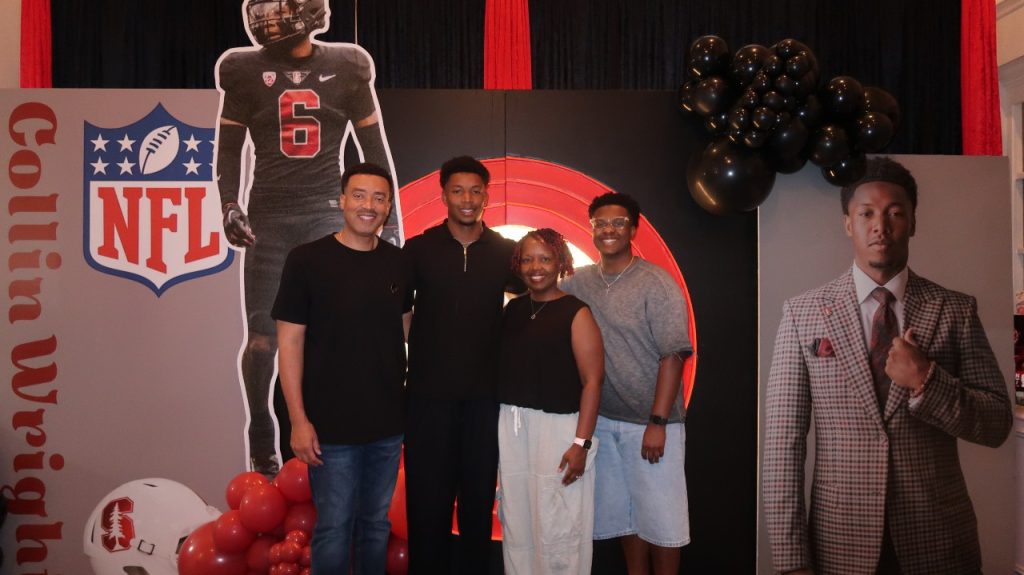
On the morning of April 25, Collin Wright opened his eyes in his childhood bedroom in Houston, a day he had been waiting for since he first picked up a football, 17 years ago.
Before he’d even come downstairs, the house had already told the story.
Life-size photos of Wright in his Stanford uniform lined the walls. A lit backdrop read “Draft Day” in bold letters, decorated with balloons and framed by a setup his mother had sourced from a local party rental company. She had thought of everything: Italian catering, background music playing softly, every detail arranged so that her son could walk downstairs and do one thing: watch.
Wright came down in a black collared shirt, black trousers, and Valentino shoes. He made his usual oatmeal with maple brown sugar, peanut butter, and honey, then sat with those closest to him. His mother kept the guest list small, about 15 people, all waiting on the same call saying he’d been drafted by an NFL team.
Every year, 32 NFL teams spend three days and 257 picks selecting the players they want. Wright, a defensive back, had watched two days pass without his name being called. He had hoped to be among the earlier selections. For most players, the money and stature that come with being drafted matter, but that’s rarely the whole story. It’s about the moment.
Day 3 of the NFL Draft started at 11 a.m. Central time. All Wright had to do was wait. He waited. And waited. And then the draft ended, and his name had not been called.
He had done everything right. He had attended the Senior Bowl, went through the NFL combine, and checked every box the NFL asks of prospects. But professional football is a business, and on draft day, nothing is guaranteed. For Wright and his family, the explanation was simple. “You’ve done all you can do, and you’re waiting for God to make the decision,” his mother, Lisa Wright, told him. “He’s going to put you where you’re supposed to be.”
This is a story about the call that never came, and the one that changed everything.
The shift crept in slowly, pick by pick, name by name. With every cornerback called that wasn’t named Collin Wright, the air in the room grew heavier. Nobody wanted to say what everyone felt—his worst case was getting drafted late, with not even a thought about going undrafted.
As the later rounds passed, Wright retreated upstairs, away from the TV and the names being called. “When you dream of playing in the NFL, you think about hearing your name on draft night,” Wright said. “The money and spot don’t matter. You just want to hear it called.”
His mom came up to check on him. She didn’t have words so much as she had faith. “Let’s pray,” she told him. “It’s okay. You’ve gotten here. However, it turns out, God knows best.”
Jayniana Williams, his girlfriend, went up too. “He only showed his emotions to his mom and me,” she said. “He was crying.” Privately, she was unraveling, too, but didn’t show it. “I kept telling him it’s going to be okay, even though I was freaking out inside.”
The stats said he should have been fine. Wright was ranked as the 24th best cornerback in Division I and every cornerback rated above him had already been drafted. “There was no reason he shouldn’t have been drafted,” Williams said. “The numbers told a different story.”
NFL teams do what’s best for them, and sometimes numbers matter less than negotiations. “Hard work doesn’t guarantee results,” Wright told Williams. She had seen his work ethic up close for years: the diet, early mornings, weekend workouts. But at the end of the day, the NFL acts in its own interest.
Then it was over.
The final pick of the seventh round was announced, and Collin Wright’s name had not been called. He came downstairs, surrounded by the people who loved him most, nobody quite sure what to say.
His phone rang, his agent, Shawn O’Dare calling, Wright was still upset. But as he described it, the business hadn’t waited for his emotions to settle in the later rounds; teams had already been calling his agent, negotiating deals before the draft even finished. That’s how it works: by the time the final pick is announced, the market for undrafted players is already moving. His agent called minutes after it ended, then again about eight minutes later. The news was good. Wright had a choice to make.
Minutes later, the phone rang again. Wright stepped outside to take it. When he came back in, he had an answer. It was the Houston Texans, a team he’d already visited, a coach he’d met, a city he grew up in, twenty minutes away. He was coming home.
For his mother, the moment was everything. “It was like exhaling,” she said.
She always told him the Stanford degree was the real prize; everything else was icing. “The draft was a cherry on top,” she said. “But what matters is that he made it. He’s an NFL player.”
“I never thought I’d play here,” Wright said. “I don’t have to get on a plane or find an apartment. I’m around my family. It’s a blessing.”
“He’s always been the underdog,” Williams said. “It’s only up from here.”
Gaethan Bernadel, a close friend who played linebacker alongside Wright at Stanford, sees what people will overlook: Wright is football smart, Bernadel said,and that translates to speed. You can’t play fast unless you know what you’re doing.
But beyond the label, what he did that day was simpler than any of it. He made it. “His community and his faith are the pillars he lives by,” said Williams. “When he’s weak, God lifts him up.”
Bernadel put it even more plainly: “The Texans got a steal.”