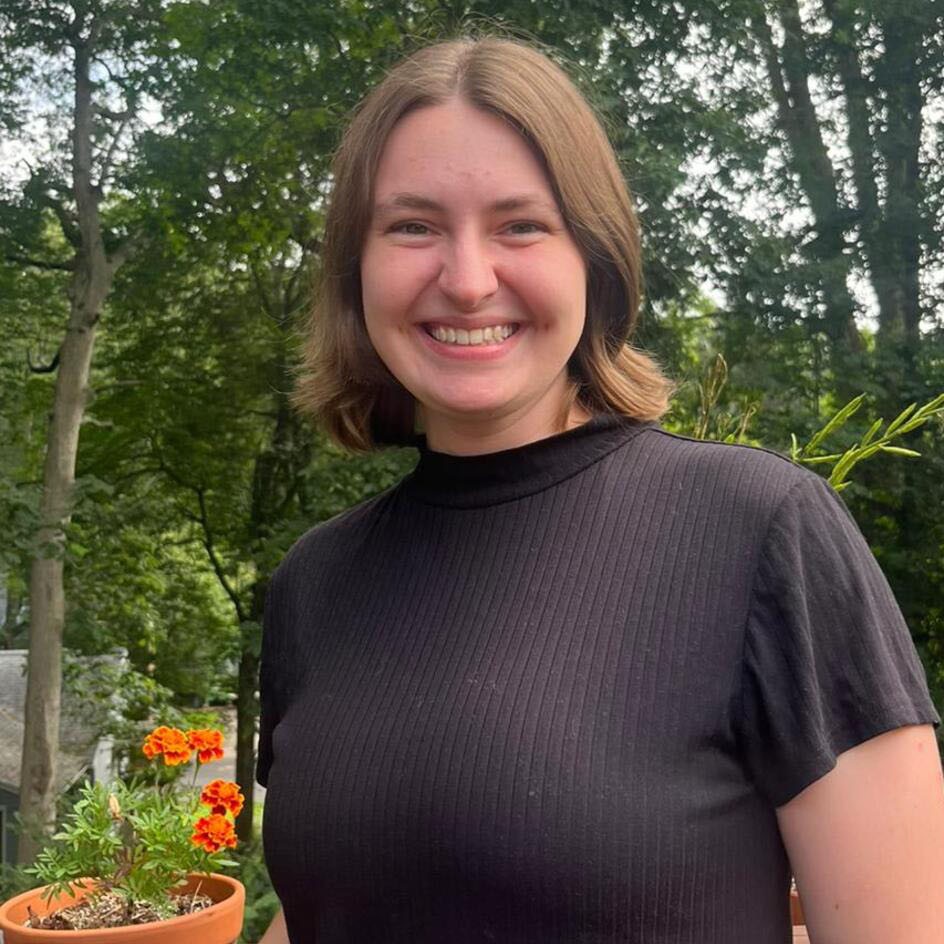
Update July 6, 2026: Since the publication of this story, Laine Higgins has left the Wall Street Journal to pursue an MFA in creative writing with a nonfiction concentration at Columbia University.
Whenever Wall Street Journal sportswriter Laine Higgins enters the press box at Mercedes-Benz Stadium in Atlanta, the attendants check credentials before letting sports journalists in.
Or they’re supposed to.
“Every time I’m in a group, they don’t ever ask the men. They always ask me,” said Higgins, 31. She knows they’re just doing their jobs, but still… “When you’re a man and you walk into these rooms, I think people just assume you’re meant to be there,” Higgins said.
When you’re a woman, sometimes people assume you’re not meant to be there. Years earlier, as a 22-year-old sportswriting intern at the Journal, Higgins set out to interview an eye doctor and an MLB scout for a story about baseball pitchers’ generally superb vision. She arrived at the doctor’s office early and waited 15 minutes with no sign of her subjects — until she realized they’d started without her.
Maybe it was her androgynous name, she said. Maybe they were expecting a man named Laine Higgins.
When Higgins introduced herself to the doctor, he met her with condescension. “You’re here for the Wall Street Journal and you write about baseball?” she recalled him asking incredulously.
Moments like these never stopped her.
“I know I can write well, and I know I can tell a good story. It doesn’t matter if people underestimate me,” Higgins said. “I know the product I’m going to produce for The Wall Street Journal is going to be good.”
Higgins, who has spent the last seven years at the Journal as a full-time sports reporter and now counts the NCAA as her primary beat, works at a time when less than one in five sportswriters are women, according to the career data site Zippia. At the Journal, she’s covered disparate topics from the professionalization of college sports to the icy thrills of the National Hockey League to an inside look at Olympic swimming — her insights into the latter shaped as a former Ivy League swimmer herself.
That’s something unique Higgins brings to the Journal, according to her colleague, Rachel Bachman, the Journal’s senior sports reporter: “[She] takes her own personal knowledge of a sport and leverages it for an idea that many people had no idea existed.”
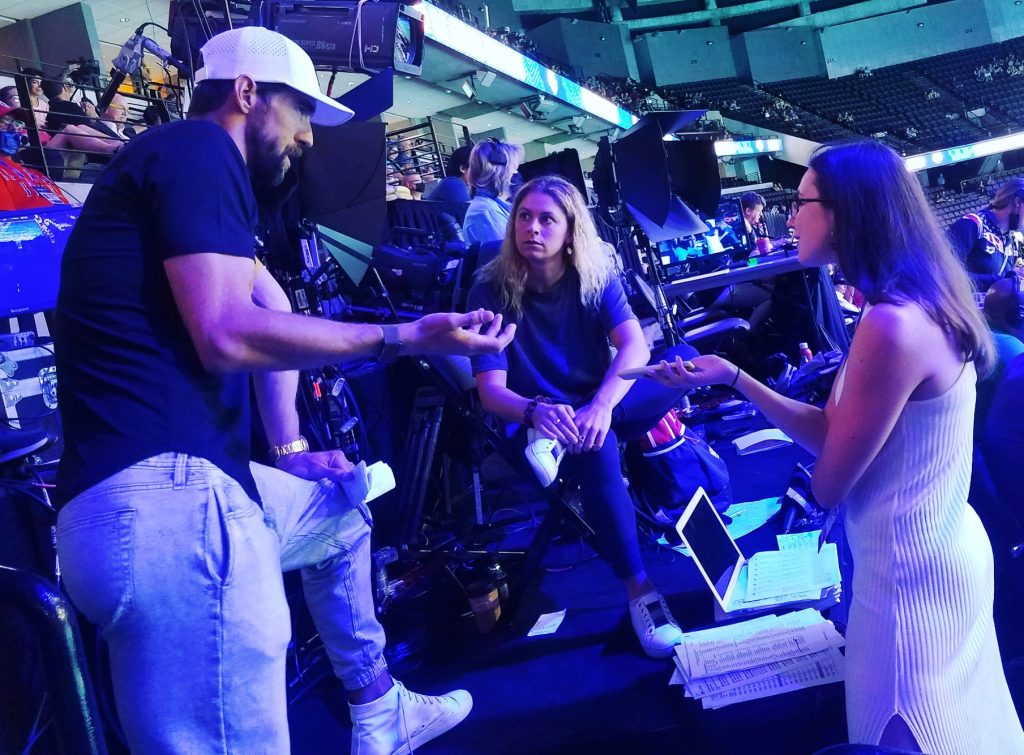
Consider one of Higgins’ proudest off-beat stories: Olympic swimmers pee in the pool.
In the 2024 Olympic swimming trials, Higgins set out to pitch an “A-Hed” — a quirky, lighthearted feature for the Journal. Thanks to her insider knowledge, she intended to write about the hilarity of ripping a technical race suit right before an event. (In the world of swimming, the unfortunate mishap is not uncommon.) Offhand, she mentioned to her editor that tech suits are so tight, there’s no time to peel them off if nature calls before a race. If swimmers gotta go, they gotta go… in the warm-up pool.
“Doesn’t everyone know this?” she remembered saying. Not unless you swam like Higgins. The A-Hed was born.
She recalled flagging down former Olympian Missy Franklin in a hallway to see if she “could ask her a really weird question about peeing in the pool” (she said yes), and strategically timing her approach with others to ensure her questions didn’t come after a disappointing performance.
“If someone’s just placed third and is absolutely crushed, you’re not gonna ask them about peeing in the pool,” Higgins said.
Being a former swimmer didn’t just help Higgins identify the story. It also helped cautious competitors feel comfortable opening up to her.
Higgins is proud of her serious reporting, too. But her favorite stories are “whimsical” and even a little silly. She enjoys covering the “underbelly of sports,” an area she believes is “ripe for more exploration.”
She grew up swimming in her hometown of Wayzata, Minnesota, where she would “bike to the pool all the time” and “try out every single sport.”
It could have been any number of moments that foreshadowed her career.
Maybe it was rushing home from babysitting the neighbor’s kids to catch the 2008 Olympics on TV, and watching the 100-yard butterfly where Michael Phelps out-touched his opponent by a hundredth of a second.
Maybe it was going to the 100th Michigan-Ohio State football game in 2003 with her dad, where she got to walk onto the field and see the massive players up close.
Maybe it was reading Sports Illustrated cover to cover, which most kids didn’t do. Higgins wasn’t even a huge bookworm as a kid, her older sister Sutton said, so being hooked on the magazine was “definitely motivated by a love of sports and less a love of reading.”
Or maybe it was producing The Higgins News, a family gazette Higgins would mail to her cousin in Olympia, Washington. Writing about how your dog was always hungry isn’t exactly hard-hitting, Higgins recalled, but she enjoyed playing with the layout.
Whatever it was, Higgins was always “someone who has been creative, curious and interested in narrating life,” Sutton said. “When she decides she’s committed to something, she’s all in.”
But Higgins hadn’t committed to journalism just yet. Thanks to a harsh middle school teacher and a string of faculty turnovers throughout high school, she didn’t think she was a good writer until she started crafting personal essays her senior year, when her instructors insisted she had a knack for it. Still, the thought of making a career out of it hadn’t crossed her mind.
But the making of the journalist was there.
As Higgins began her college application process to the University of Pennsylvania, she met Robby Sikka, then-director of Penn’s alumni interview program in Minnesota. Sikka would become her mentor, Higgins said.
Most prospective students, Sikka said, would ask him what he liked about the school, what classes he took and what he wished he had done differently. Higgins was different. Observant and curious by nature, she asked a question, listened to Sikka’s answer and thoughtfully responded to it. She wanted to know, at the next level, what was possible for her at Penn.
“That described, to me, somebody who’s a little bit more of a dreamer. Somebody who has bigger ambitions, and who wants to do things with their education,” Sikka said. “She had the ability to listen, observe and take that information and process it quickly, which I think the best journalists do.”
Surely it was once she started at Penn that Higgins decided on journalism. Well, not quite.
“I came in and was convinced that I was going to go be a diplomat and work for the State Department,” Higgins said. She knew she wanted to major in international relations, which is ultimately what she did, and casually considered a minor in journalism.
As an incoming member of the varsity swimming and diving team, Higgins joined the sports section of the Daily Pennsylvanian, Penn’s student newspaper. She thought it would be a great way to make friends with other athletes, not grasping the time commitment — nor that it’s hard to make friends with other athletes when you’re interviewing them about why they lost a game. She didn’t get a byline on her first story, a soccer recap, because it was “so bad” that her editor rewrote it.
Higgins stuck with it. She got her first byline on a column and, story by story, figured out the cadence of news writing. After about a year, she became the sports section’s deputy editor. That meant added responsibility to an already busy schedule of classes, sorority commitments and morning and afternoon swim practices. Sometimes she’d be in the newsroom from 5 p.m. to 1 a.m., helping to grind out an edition, or scrambling to write a squash recap when a reporter never filed one.
Higgins interned at USA Today, the Philadelphia Inquirer and Sports Illustrated through her college years, and then at the Journal following her graduation in 2017. Half a year later, the Journal hired her back as a reporting assistant, and in two more years, she became a full-time sports reporter.
That role took her to the winter Olympics in Italy and the summer Olympics in France. It took her to writing about dramatic transformations of the NCAA, rising stars in the NHL and, on occasion, to women’s sports issues — something she finds fulfillment in reporting on.
“The experience of being a female athlete is just so different,” Higgins said. It’s frustrating and “mind-boggling” to her when she hears coaches shun menstruation with barely an understanding of women’s health, or when reporters comment on women’s bodies in ways they “would never do [with] a guy.”
“As a journalist, I feel somewhat of a responsibility to cover this stuff,” Higgins said. “If we write about it, then people will pay attention.”