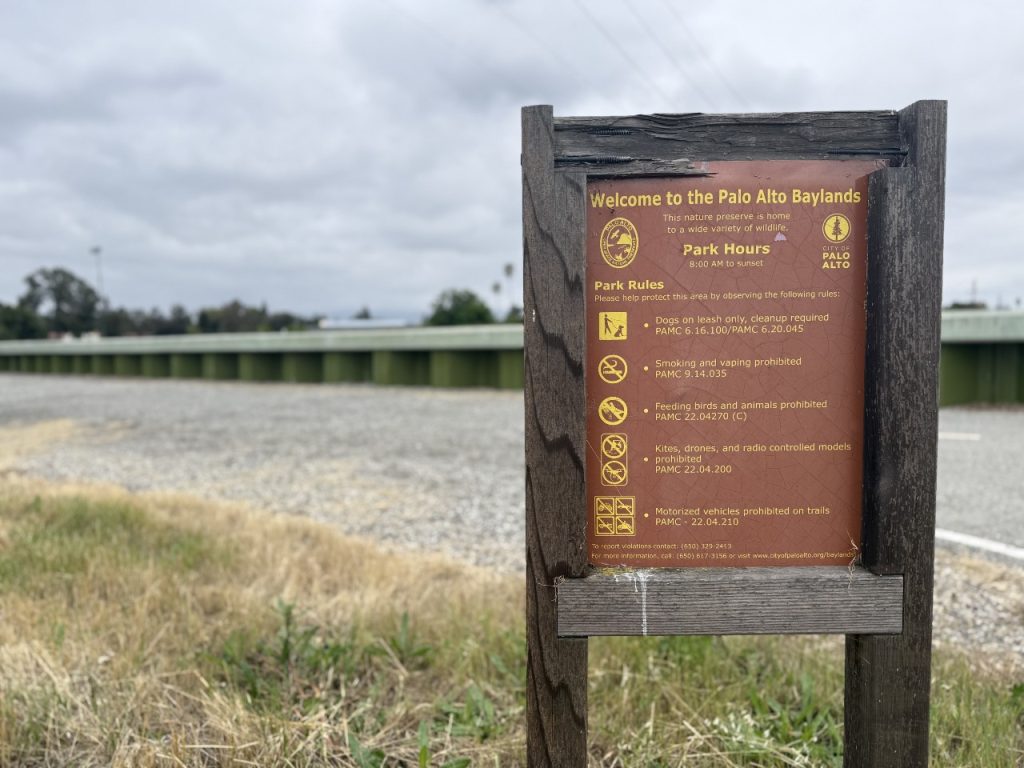
PALO ALTO — On a cloudy Saturday morning at Baylands Nature Preserve, all is quiet save for birdsongs and a couple early-risers trotting on a crushed gravel trail.
At about 8:50 a.m., a few cars roll into the parking lot. Then more. Now, about 70 locals dressed in running clothes — most older, some middle-aged, with a few young adults scattered between — greet each other with hugs and chat in small groups. Some wear hats with rainbow letters reading “BayLands FrontRunners.”
That’s the name of this local, LGBTQ+ running club, which has brought queer people together for runs and walks for 35 years. Though it primarily serves LGBTQ+ people, anyone is welcome to attend.
Founded in 1991, BayLands FrontRunners is a local chapter of the International Front Runners, which has LGBTQ+ running and walking groups across the U.S. and the world.
But BayLands is more than a running club. It’s where longtime members once sought out fellow queer people in a far less accepting America; where new residents come to make friends; and where some have even found love.
“For the people who are not out at work, this is a place where they can be themselves,” longtime member Warren Snaider, 79, said. “For the people who are out at work, this is a place where they can be out with other gay people. For straight people, it’s an opportunity to see how the other half lives.”
In the early 90s, it was difficult to meet fellow queer people, Tracie Johnson, 62, said. Gay bars were an option, but for those not interested in drinking, finding a community could be especially hard.
Johnson preferred the outdoors. When she joined BayLands in 1994, it provided a fun, healthy alternative, where she could meet fellow queer people in a safe environment.
“That’s how I met my wife,” she said, smiling.
It was similar for Peter Sass, 75, who joined in 1996. Already a strong runner, he would meet someone new on the trail and have conversations with them about coming out: “How you do that, and what that’s like,” Sass said.
“We all have that big item in common,” said Sass’ partner, Patrick Champagne, 79. Champagne joined in 1992, and like Johnson and her wife, the couple met at the club. “I don’t know anybody yet that has said there was never a coming out.”
Whenever Ariana Chini, 34, walks with someone new, especially queer elders, they always ask them what their coming out story was like. They ask her, too. Hearing about their lives blossomed into “cross-generational, queer friendships” that are “so precious” to her, Chini said.
“I’ll always share that I didn’t have an easy coming out story. My parents are Muslim immigrants from Iran and India, and they were very close-minded, and I had a really hard time with them, too,” said Chini, who joined about a year ago and serves on the board as the DEI advocate. “These folks are always fascinated hearing my story as well, because I just come from a different culture than them.”
Champagne, who serves as the group’s registrar, said there was steady growth from the club’s inception in 1991 to about 2000, when membership skyrocketed to 600 people during the dot-com boom. Those numbers tapered off, but the club has remained “viable,” Champagne said. Today there are about 250 members.
Every Saturday morning, the FrontRunners host a “fun run” at its namesake park in Palo Alto, where participants run — or walk — a three- or five-mile loop. Afterwards, they socialize at a local coffee shop. (Attention, first-timers: your first coffee is on them.) They also host a few runs throughout the week.
You don’t need to be an athlete to join BayLands, but many longtime members were serious runners. Take the Hood to Coast relay: an endurance race spanning the 200 miles between Mt. Hood and Seaside, Oregon. A team of 12 runners alternated through taking on a three-to-six-mile leg, switching off at designated changeover points and racing deep into the night. They would run through vineyards, weave through tourists and sometimes even get lost.
But as BayLands grows older, so do its longtime members. Many who were once runners are now walkers, and though BayLands is a place to have connection, “unfortunately, the older part of the crowd is connecting on health issues now,” Johnson said. That’s part of why she likes it when young people come: they’re at a different life stage, so they’re talking about different things.
“I remember feeling excited about that kind of stuff,” she said. “I really love it when the younger people in the club share where they’re at.”
Chini said that because the club is mostly made up of older, white men, sometimes it can be difficult for women and other minorities to feel seen. As DEI advocate, Chini tries to bring more gender diversity to the club, and provide “gentle guidance” for elders on using gender-affirming pronouns that “could make a really big impact” on trans and nonbinary folks’ experience.
“It’s already such an amazing group,” Chini said. “Small, manageable changes [could] allow the group to be more sustainable long-term as we get more folks to come.”
At 9:00 a.m. “circle-up” before the run, organizers distribute rainbow pins for newcomers. That way, veterans can identify them and start a conversation. Everyone goes around and shares their name. Following announcements, the FrontRunners — and walkers — set off.